You Meet in a TavernPart 1
You Meet in a Tavern - a rules-light D&D alternative
The birth of a new TTRPG for new players
I’ve been there, you’ve been there, anyone who’s been in the TTRPG hobby as a GM has been there.
You want to play the games you love but your regular players are not available. You’ve managed to garner the interest of some less nerdy friends and you’ve all decided to play a D&D one-shot. Then the problems start.
Character creation is HARD, so you have to help every player create their character. You explain how to roll the abilities, then explain to them what each means and which they “should pick” for the class they want to play. Then they pick the race that maximizes their stats. As you go along you try to explain how checks and saving throws work and you struggle to answer why attacks require an attack roll and a damage roll separately. Then you track proficiencies, resistances and vulnerabilities, most of which don’t even come up during the one-shot. And oh boy, pity the poor guy who really wants to play the wizard. Just wait until he looks at the spell list and gets overwhelmed by the number of spells while somehow not having the spells he had in mind. If he isn’t lost by now then explain to him a couple more rules. Explain to him that attack spells roll like regular attacks while others depend on the saving throw by the target. That should do it.
But hey! You’ve done it! It was cumbersome and tiring and they no longer remember half of what’s on their character sheet, but it doesn’t matter. You’re finally at the table and they’re gonna have fun. They’re going to finally experience the freedom of choice and creativity that has been forever promised.
Until someone tries to do a jumping attack:
Player: I raise my sword and jump off the ledge. I use the falling momentum to power my swing as I hit the enemy from above.
DM: Roll with advantage.
Player: That’s it!? no extra damage?
DM: No…
At this point everyone is so overwhelmed with rules that they can’t really think outside the mechanics in their sheet.
Sighs… Sorry about the rant, I’ll compose myself.
You see, I’m an adult now with adult things to do, and that means having less time to play, even less time to prep, and a harder time finding time to meet with all my adult friends. Because of that, most of my playtime has been with one-shots introducing new people to the game.
The advent of OSR/NSR
Games like Cairn and Shadowdark solved most of these issues and saved me from leaving the hobby. Being rules-light, both games really helped reduce prep time and gave my players some space to breathe and enjoy the game without getting lost in the rules.
But one complaint remained: “This doesn’t feel like D&D…”
The problem, framed
My players want to play the D&D they imagined not the one that exists. Unlike Cairn they want classes. Unlike Shadowdark they want a less gritty experience. Unlike D&D they want powerful yet easy to play characters.
So I rolled up my sleeves
For the past week I’ve been designing You meet in a Tavern. And here’s what it looks like so far:
D20 checks. The D20 is a staple of D&D and one of the most satisfying dices to roll. So even though other dices would make the system simpler I’ve decided to stick with it.
No ability or skill scores. What’s the difference between 17 and 18 INT? These numbers mean very little for new players. Instead you pick features and flaws during character creation and ask the GM to add +/- 2 to a roll for each relevant keyword. (ie. +2 to a grapple roll because your character is strong, or on a dodge if it’s nimble).
Same mechanic everywhere. +2/feature, -2/flaw, end of story. In battle situational keywords act like advantage. Hitting an enemy while unseen gives you +2, trying to attack someone while being confused? -2.
Rulings over rules. The problem with having a thousand rules is two-fold.
- You need to either memorize them or pause the game to find them.
- When one is missing you need to come up with one that balances with all the others.
Instead I prefer the rules-lite route, a sleep spell makes someone fall asleep, what that means at your table is up-to-you my advice is to follow common sense and when in doubt fallback to the +/- 2 rule.
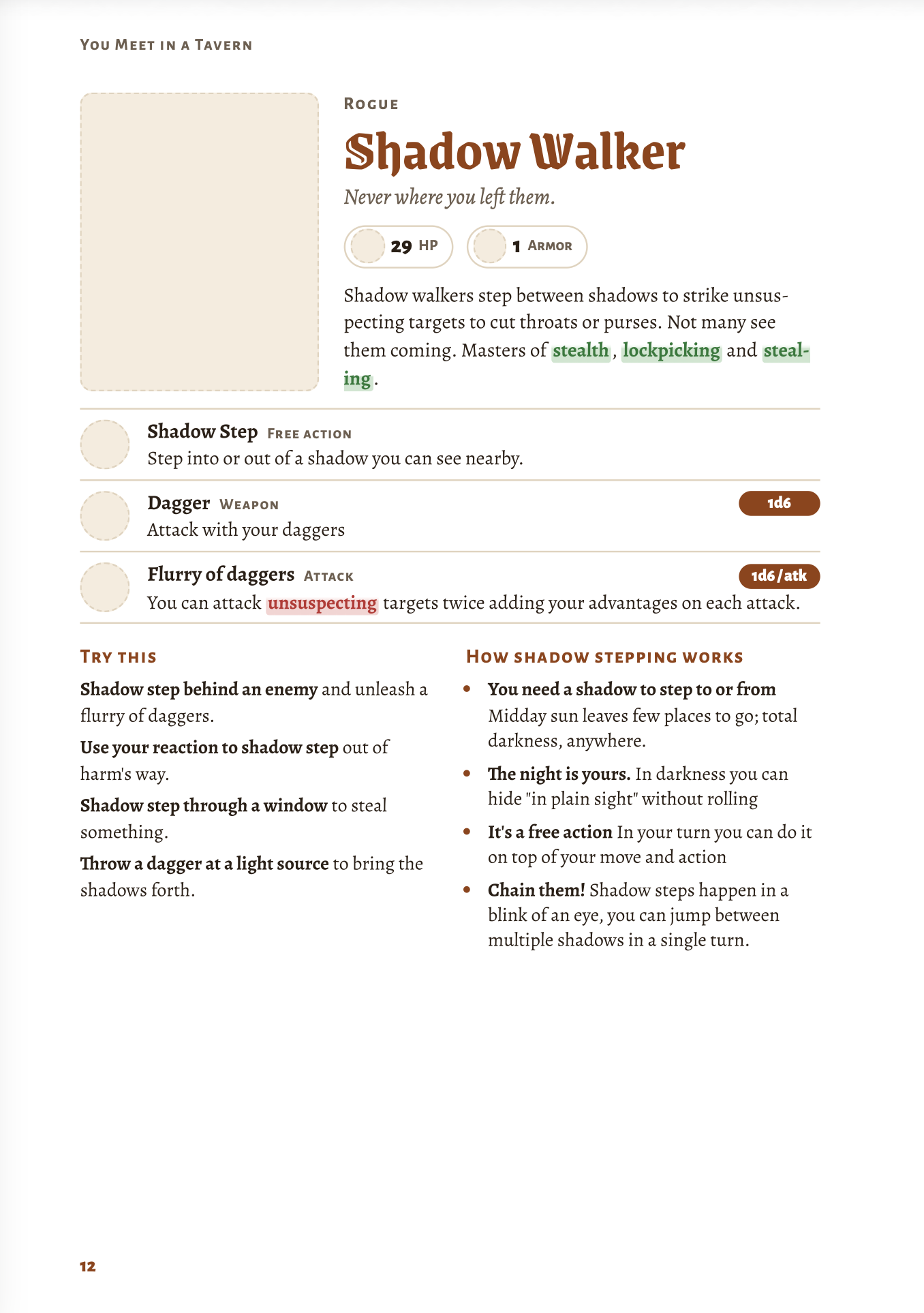
Flavorful classes. The classes are easy to play while feeling powerful. The ease of play of a 1st/2nd level character with the power of a 4th/5th level (in D&D terms). “Shadow Walker rogues” can teleport between shadows, “Dragonsoul monks” can bend fire at will, etc.
1-3 shot only. Designing without progression lets me do some funky things with numbers and simplify the design of the game. It also means I can choose the power level arbitrarily without worrying about how to stretch it across N levels of character advancement.
Mechanic-free races. I enjoy the idea of races in fantasy games, they add a lot of flavor, but they’re also extremely stereotyped in D&D. There’s no reason why you shouldn’t be able to make a barbarian gnome work.
Anyway
That’s the announcement I wanted to make. In the coming days/weeks/months I’ll be writing about it, going over design decisions, new classes and the overall process. For now you can take a look at the current iteration of the Rogue (Shadow Walker) class.